

A Mother Was Found in the Kitchen, and a Father in His Recliner.
How fatherhood changed, and why motherhood changed with it.

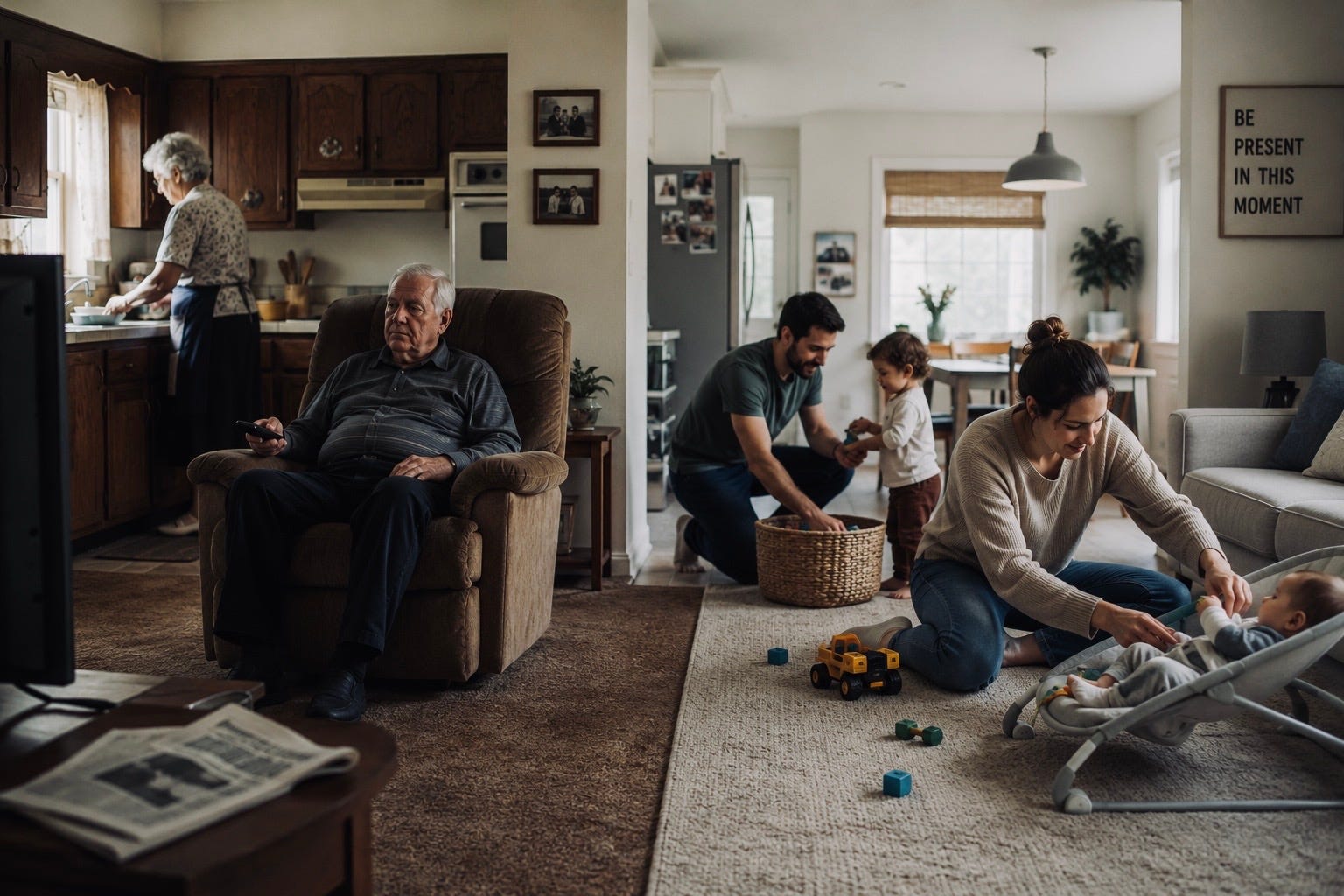
If you had walked into many American homes fifty or sixty years ago, you likely would have known exactly where to find everyone.
Mom would be in the kitchen or tending to children. Dad would be in his recliner with a newspaper or watching television.
This setup has also been present in more recent decades. I remember holidays spent with family as a child, where the women slipped into their “rightful” roles while the men relaxed, talked, or caught up on the latest sports game. Even as a child, I remember feeling annoyed at this dynamic. I couldn’t understand why women were expected to make meals for a couple dozen people, tend to their children, and then clean up everything afterwards, all while men were able to fully enjoy the downtime of the holiday and expected a warm meal waiting at the time they expected dinner to be served.
Part of my indignation came from my own household, where family roles were much more nuanced. Both my mother and father stepped outside of many traditional roles. It was not uncommon to see my mother outside with a lawn mower or my father cooking/ cleaning in the kitchen and also caring for my needs. Growing up with this dynamic as my “norm” made those opposite dynamics difficult for me to understand.
This is not to say that there weren’t fathers who were deeply involved with their children long before parenting books encouraged it, and there are still fathers today who leave mothers to carry far more responsibility than they should. No generation has had a perfect balance of great, involved dads or absent ones.
Still, our culture does tell us a story about expectations and household roles.
For many generations, fatherhood was largely defined by one responsibility. Providing. A good father was one who worked long hours, made sure there was food on the table, and paid the bills. A father’s love was often expressed through protection and provision. There is respect earned for this role, but I would say just as much respect was earned by the mothers who kept the rest of the household together and functioning.
Today’s fathers often face different expectations than those in prior generations.
Many fathers do still protect and provide, but they also are comfortable changing diapers, packing lunches, taking kids to doctor’s appointments, reading bedtime stories, and knowing the ins and outs of their children’s preferences.
This generational shift has changed far more than family routines, but also the way in which childhood is experienced.
Children who grow up watching both parents nurture them learn that love isn’t divided into “mom’s job” and “dad’s job.” They grow up seeing comfort, discipline, play, responsibility, and emotional presence modeled by both parents. They learn that raising children isn’t “women’s work”, but family work. I think this mindset is hugely beneficial for children living in today’s world.
The benefits also extend far beyond the acts of raising children.
When a father shares the work of parenthood, motherhood becomes more manageable as well as more enjoyable. Being a parent was never designed to be an easy job, but when the weight of the responsibility rests on two sets of shoulders instead of one, it does become lighter.
In modern times, an involved father does far more than basic household chores or offer to “help” with the kids. True involvement means sharing the invisible work that so often goes unnoticed: the same mental load women carried on their shoulders for years, often all on their own. Many fathers today know the shoe sizes of their children, their snack preferences, their bedtime routines, and the names of their teachers. A modern father doesn’t have to wait to be asked because he carries ownership right alongside the mother.
The modernized version of what a parenting partnership looks like in many households now also changes a mother’s experience in ways that statistics could never fully express.
Tangibly, this looks like mothers who have the space to breathe and take time to themselves.
Many mothers now have someone who understands why they’re exhausted without needing an explanation on basic motherhood responsibilities. One of the most significant changes is that mothers have another adult in the house who knows how the household works because he also helped to create it.
These are dynamics that were far less common even a few generations ago.
We constantly hear conversations about how mothers need a village, and this is undeniably true. Grandparents, neighbors, friends, teachers, and communities can all be part of this support system. Yet the foundation of that village begins inside the home, within our own four walls.
If I had to put one word to the biggest change between fathers of prior generations and today’s fathers, it would be “presence.” Physical presence is not in any way the same as mental and emotional presence, and this is the change I am talking about here.
Something that children remember into adulthood is what it felt like to grow up in a home where both parents equally showed up for them, in their own unique ways. This also impacts the way that those children then interact with their own future families.
I see evidence of this in my own life. When looking for my own partner to raise children with, I looked for a man that would stand alongside me in every aspect. It was important to me to marry someone that wanted to be an involved father and knew what that actually looked like in practice. In having two sons myself, it is such a blessing to know that they will grow up thinking their father’s involvement with them is “normal”. And it is something I hope they carry into their own families with their own children one day.
I am not sharing this to negate the roles of all the fathers in generations before.
So much progress has been made, but it also doesn’t require dismissing the fathers who did come before our time. Many fathers loved their families and gave everything they had within the expectations of their time. Their sacrifices built the foundation that has allowed future generations to redefine what fatherhood looks like.
Fathers have always had the capability to nurture their children. The beauty is that our culture increasingly expects and celebrates that kind of involvement rather than viewing it as unusual or unnecessary. This change is one I think will continue and I truly hope it does.
Children deserve fathers who are fully present.
Mothers deserve partners who share the work of raising a family.
And ultimately, every family deserves a village that starts in their own home.
This is a great read, and your description about your own family of origin dynamics it made me remember a conversation I captured a couple of years ago, with my 10-year-old son…
—
Tonight, Caleb asked me whether it was painful to get Botox.
“I have no idea,” I said, surprised.
This led to a conversation about plastic surgery, what that was, why some women chose to get it, and how society tends to have different expectations for women than men. Still.
“But can you imagine if things were the other way around?” Caleb asked. “I can’t even imagine a world where lots of men get plastic surgery.”
“Not really,” I said.
“And can you imagine a world,” Caleb continued, his tone full of speculative wonder, extending his imaginative flight of fancy, “Where women do the dishes? Or wash the clothes?”
“No,” I said with a straight face, listening to the sounds of my husband finishing up the dishes downstairs.
“And I can’t believe men used to control women,” Caleb said. “Why would you do that to your wife? Someone you love. I can’t imagine Dad controlling you.”
“Neither can Dad,” I said, laughing.
This was beautifully written (as always). Let’s hear it for millennial dads changing generational norms! I could not be the mom I want to be without my husband being the dad he needs to be. I’m so grateful for him every day.